
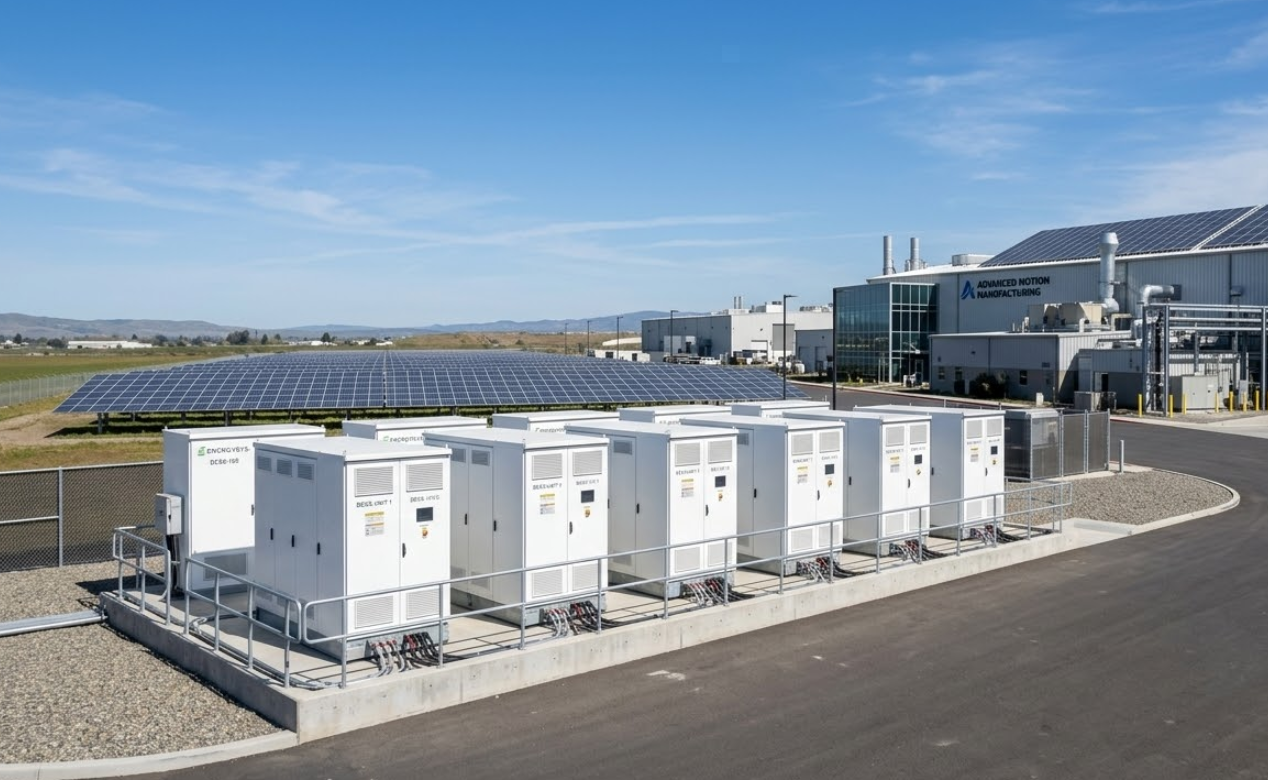
When configuring a 2MWh commercial and industrial battery energy storage system (C&I BESS), the biggest dealbreaker for facility managers and EPCs isn’t usually the initial CAPEX—it’s fire risk. A single thermal event can jeopardize millions of dollars in infrastructure and halt operations indefinitely.
In the manufacturing and engineering side of energy storage, we constantly evaluate cell chemistries under extreme stress tests. While the market primarily debates between Lithium Iron Phosphate (LiFePO4/LFP) and Nickel Manganese Cobalt (NMC), the safety profiles of these two dominant chemistries are fundamentally different. If you are navigating the complexities of commercial BESS safety standards, understanding what happens at the molecular level, during heavy cycling, and even during ocean freight is critical.
Here is a hard-engineering look at why battery chemistry dictates the ultimate safety of your commercial energy storage project.
The Chemistry Behind the Safety: Why Thermal Stability Dictates Choice
Safety starts at the molecular level. The inherent risk of any lithium-ion battery is thermal runaway—an uncontrollable, self-sustaining heat chain reaction.
In NMC cells, the cathode structure relies on weak metal-oxygen bonds. If the cell suffers physical damage, overcharging, or an internal short circuit, these bonds break down relatively early (around 150°C to 210°C). The catastrophic part? Breaking these bonds releases pure oxygen. An NMC fire essentially feeds itself from the inside out, making standard fire suppression methods largely ineffective.
Conversely, LiFePO4 (LFP) utilizes strong covalent phosphorus-oxygen (P-O) bonds in its cathode. This olivine structure is incredibly robust. When comparing the thermal runaway temperature of LiFePO4 vs NMC, [authoritative studies from organizations like Battery University] show that LFP can withstand temperatures up to 270°C without breaking down. More importantly, even if an LFP cell is driven into thermal runaway, it does not release oxygen.It will smoke and vent, but it strongly resists catching fire.
Table 1: Core Chemistry and Safety Parameter Comparison
| Parameter | LiFePO4 (LFP) | NMC (Nickel Manganese Cobalt) | Safety Implication in C&I Environments |
| Thermal Runaway Temp. | ~270°C (518°F) | ~150°C to 210°C (302-410°F) | LFP has a significantly higher tolerance to overheating before runaway begins. |
| Oxygen Release | Minimal | High (Self-oxygenating) | NMC fires provide their own fuel; LFP does not. |
| Cycle Life (80% DOD) | 6,000 – 8,000+ cycles | 2,000 – 3,000 cycles | Less frequent cell replacement reduces handling and operational risks over a 10-15 year lifespan. |
| Energy Density | 120-160 Wh/kg | 180-250 Wh/kg | NMC packs tighter, increasing localized heat generation and demanding stricter cooling. |
Where NMC Excels: The Case for High Energy Density
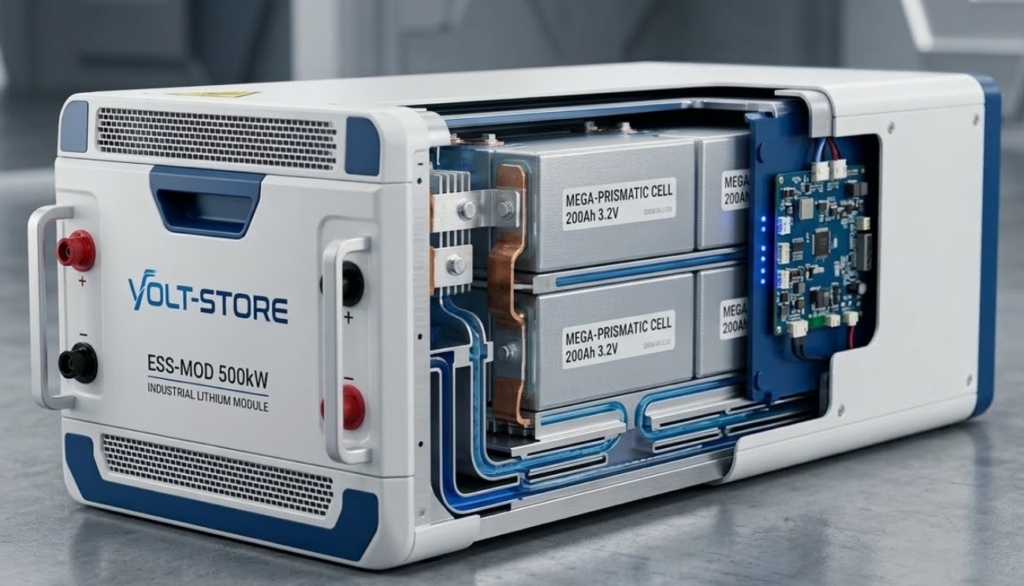
To provide a completely objective analysis, it is important to acknowledge that NMC (Nickel Manganese Cobalt) is a remarkable electrochemical achievement. With a superior energy density ranging from 180 to 250 Wh/kg, NMC can pack significantly more power into a smaller and lighter footprint compared to LFP.
This characteristic makes NMC the undisputed gold standard for the Electric Vehicle (EV) industry and mobile applications, where strict weight limits and space constraints are the primary engineering bottlenecks. If an application demands maximum energy capacity within the absolute minimum physical volume, NMC is exceptionally difficult to beat.
However, stationary Commercial and Industrial (C&I) energy storage fundamentally changes the engineering priorities. In a 20ft BESS container deployed at a manufacturing plant or solar farm, saving a few hundred kilograms is largely irrelevant. When the operational focus shifts from “mobility” to “maximum thermal safety, 15-year lifecycle ROI, and strict fire code compliance,” LFP’s structural stability drastically outweighs NMC’s space-saving benefits.
System-Level Safety: Beyond the Cell
No cell chemistry is completely immune to abuse. Therefore, safety must be engineered at the system level. This is where proper BMS thermal management for C&I lithium batteries comes into play.
Because NMC generates heat rapidly and densely, it requires aggressive, highly redundant liquid cooling systems. If an HVAC or liquid pump fails in an NMC container, the safety margin disappears in minutes. LFP, while also utilizing advanced liquid cooling in modern high-capacity cabinets to ensure temperature uniformity, offers a much wider fault-tolerance window. If a cooling component fails, the BMS has ample time to detect the temperature rise, alert the facility manager, and safely shut down the Power Conversion System (PCS) before reaching critical thresholds.
Table 2: C&I System Integration Requirements
| System Requirement | LFP BESS Design | NMC BESS Design |
| Thermal Management | Standard Liquid Cooling (High fault tolerance) | Strict Liquid Cooling with Redundancy (Low fault tolerance) |
| Fire Suppression | Aerosol / Novec 1230 / Standard Water | Demands advanced inert gas + prolonged water deluge |
| Clearance | Standard industrial setbacks | Requires larger setback distances due to blast and propagation risks |
The Impact of Aging on Safety: Internal Resistance and Lithium Plating
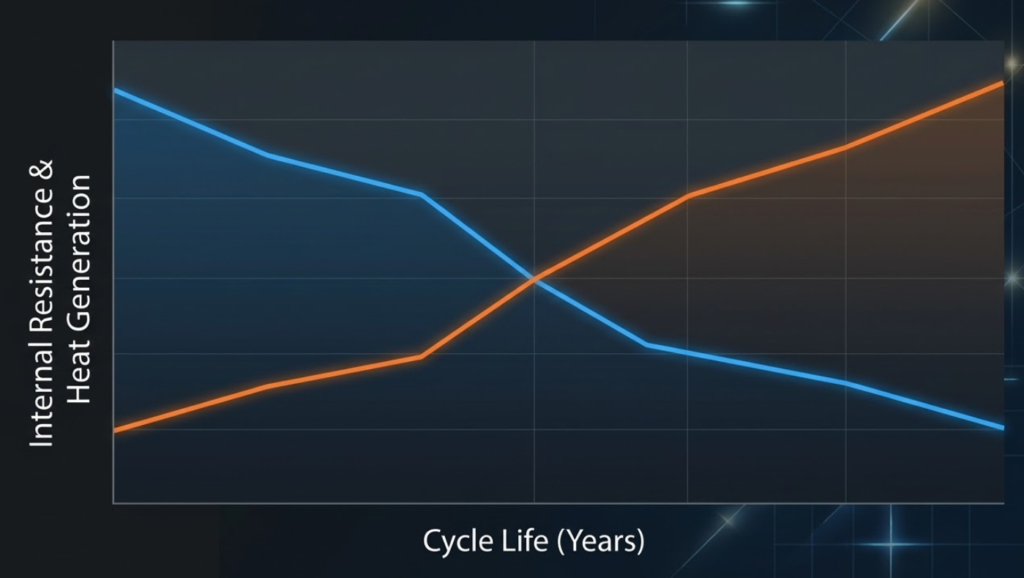
A battery system that is safe on day one must remain safe in year eight. Many buyers overlook commercial BESS degradation safety. As batteries age, their internal resistance (IR) increases. According to Joule’s first law, the heat generated is proportional to the square of the current and the resistance ($P=I^2R$).
Because NMC cells degrade faster under heavy daily commercial cycling (like peak shaving), their internal resistance spikes earlier in their lifecycle. This means an aging NMC system generates significantly more waste heat under the same load compared to a new one, putting immense strain on the aging thermal management system.
Furthermore, during high C-rate charging or low-temperature operations, NMC is highly susceptible to lithium plating—a condition where lithium ions form metallic dendrites on the anode. Over time, these microscopic needles can pierce the separator, causing a sudden, unpredictable internal short circuit. LFP’s robust crystal lattice makes it highly resistant to structural collapse and significantly less prone to dangerous lithium plating, maintaining a stable safety profile throughout its 6,000+ cycle life.
Navigating Commercial BESS Safety Standards and UL 9540A
When proposing a BESS project, your local Authority Having Jurisdiction (AHJ) will look directly at certifications. The gold standard for evaluating thermal runaway fire propagation in BESS is UL 9540A.
Testing commercial BESS safety standards and UL 9540A reveals stark differences. During cell-level and module-level testing, LFP systems frequently demonstrate an inability to propagate fire to adjacent modules. Even when forced into thermal runaway, the event is usually contained within the initial cell or module housing.
NMC systems, due to their explosive outgassing and oxygen release, often require heavy reliance on external, unit-level fire suppression systems (like dry pipes and deluge systems) to pass UL 9540A requirements. For EPCs, LFP’s inherent compliance means faster permitting, lower insurance premiums, and reduced site preparation costs.
From Factory to Grid: Logistics, Hazmat, and Commissioning Safety
Safety doesn’t begin when the system is turned on; it begins when the container leaves the factory floor. When shipping a 20ft container housing a massive battery system, the focus shifts from electrochemistry to logistics and international compliance.
Under [UN38.3 commercial battery transport] regulations, lithium batteries are classified as Class 9 Hazardous Materials. Before export, we strictly manage the State of Charge (SOC) to around 30%. Because LFP is far more thermally stable against physical shock, vibration, and temperature fluctuations during weeks of ocean freight, freight forwarders and ports handle it with less risk premium compared to highly reactive NMC shipments.
Once on-site, BESS commissioning safety is paramount. Integrating the DC battery racks with the AC grid via the PCS involves managing massive inrush currents. A robust Factory Acceptance Test (FAT) protocol ensures that the BMS and PCS communication is flawless before shipping. However, the stable voltage curve of LFP makes the initial grid-syncing and commissioning phase smoother and less prone to sudden voltage-drop induced faults than its NMC counterpart.
The Verdict: Choosing the Best Battery Chemistry for Commercial Energy Storage
If you are building a high-performance EV where space and weight are the only metrics that matter, NMC is the logical choice. But stationary commercial energy storage is a different game entirely. Facilities are not sensitive to a cabinet weighing 20% more; they are sensitive to downtime, fire risks, and multi-year ROI.
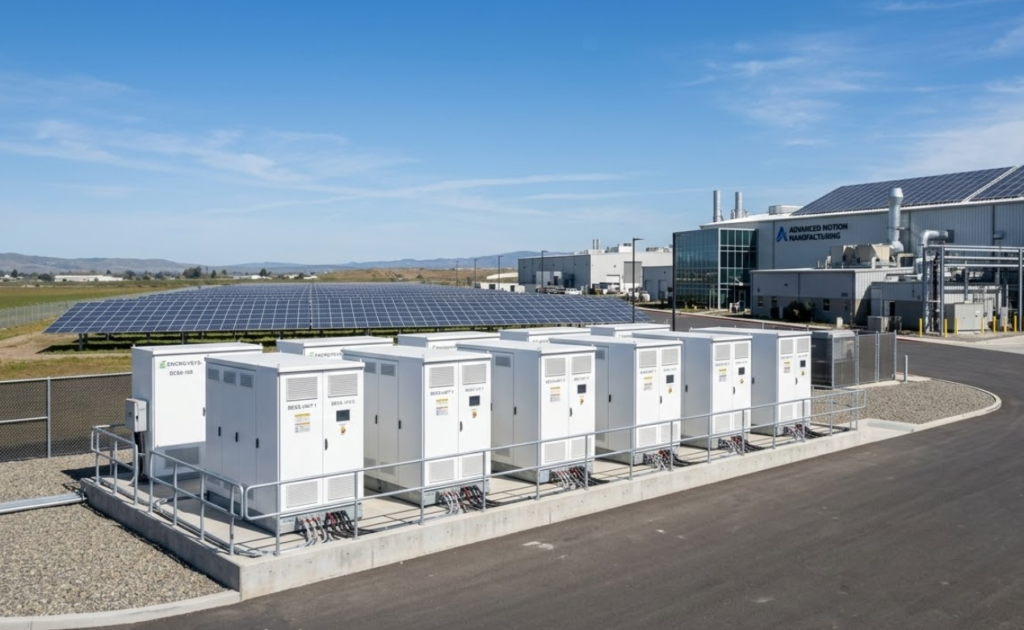
When evaluating the best battery chemistry for commercial energy storage, LiFePO4 (LFP) is the undisputed winner. Its lack of oxygen release during failure, superior thermal runaway threshold, and stable aging profile make it the only responsible choice for data centers, manufacturing plants, and microgrids.
5 Frequently Asked Questions (FAQ)
Q1: Can an LFP commercial battery still catch fire?
A: While LFP is the safest lithium chemistry with a high thermal runaway threshold (270°C) and no oxygen release, it is not entirely fireproof. Severe physical crushing or a catastrophic external short circuit combined with total BMS failure can cause a fire. However, an LFP fire burns slower, does not feed itself, and is much easier for standard suppression systems to extinguish.
Q2: Why do EVs mostly use NMC but commercial BESS prefers LFP?
A: Electric vehicles require maximum energy density (Wh/kg) to reduce vehicle weight and extend driving range, making NMC ideal. Commercial BESS installations are stationary. Facility managers prioritize extreme safety, 10+ year longevity, and a lower total cost of ownership over saving a few square feet of space.
Q3: Does LFP require liquid cooling like NMC?
A: Yes, modern high-capacity LFP commercial cabinets utilize liquid cooling. However, it is primarily used to maintain temperature uniformity across thousands of cells to maximize cycle life, rather than as a desperate measure to prevent immediate thermal runaway, which is often the case with dense NMC packs.
Q4: How does UL 9540A testing differ for LFP vs. NMC?
A: UL 9540A evaluates fire propagation. LFP systems often pass module-level testing by naturally containing the thermal event without it spreading to neighboring modules. NMC systems typically fail at the module level and rely heavily on robust, external unit-level fire suppression to pass the test.
Q5: What is the lifespan difference between LFP and NMC in daily C&I cycling?
A: In typical commercial applications like daily peak shaving or load shifting, an LFP battery will deliver 6,000 to 8,000 cycles (roughly 10-15 years) before degrading to 80% capacity. An NMC battery under the same heavy daily cycling typically experiences significant degradation after 2,000 to 3,000 cycles.


