
The global shift towards renewable energy and grid decentralization has brought Battery Energy Storage Systems (BESS) to the forefront. But if you are looking to source, install, or invest in energy storage, relying on theoretical data isn’t enough.
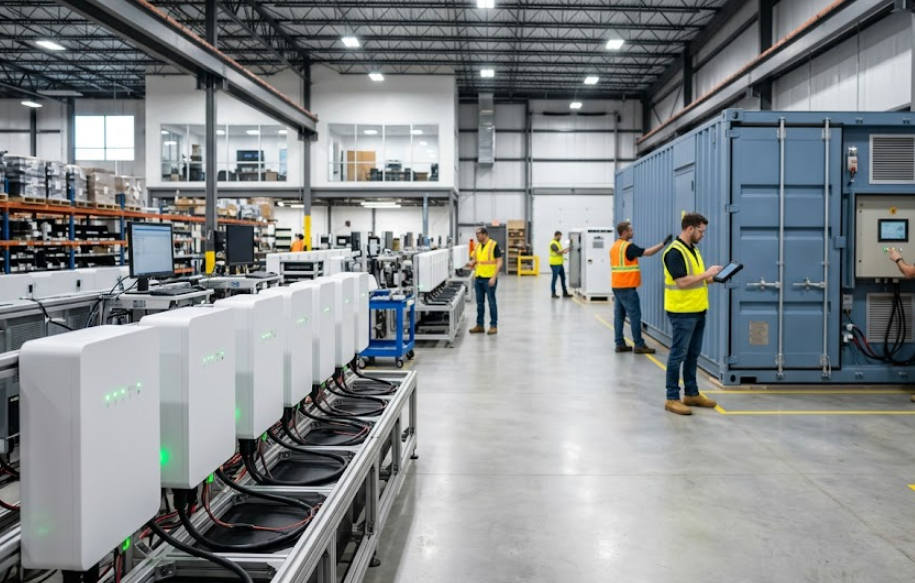
At Badar Energy, we manufacture and deliver these systems globally for our OEM/ODM clients every day. We see exactly what goes into these units—from the initial 3D CAD modeling to the final rigorous burn-in tests on our assembly lines. Today, I want to step away from the basic brochures and give you a comprehensive comparison between Commercial & Industrial (C&I) and Residential energy storage systems, straight from the manufacturer’s perspective.
We will break down the core differences across five key dimensions: scale, applications, system complexity, economics, and the all-important safety standards.
1. Scale & Capacity: Wall-Mounted vs. Megawatt Containers
On our factory floor, the most apparent distinction between C&I and Residential BESS lies in their sheer physical scale.
Residential systems are meticulously designed to meet the needs of a single household. When our engineers design a residential unit, the focus is on a compact, aesthetically pleasing footprint. These are typically wall-mounted or small floor cabinets with capacities ranging from 5 kWh to 20 kWh.
In contrast, C&I systems cater to the much larger energy demands of businesses, factories, and other commercial entities. These are heavy-duty, modular solutions. When we fulfill a C&I order, we are often configuring large cabinets or standard 20ft/40ft shipping containers capable of holding 50 kWh up to several Megawatt-hours (MWh). Operating at high voltage levels (600V – 1500V), these require entirely different structural and thermal management designs.
2. Core Applications: What Are You Actually Powering?
The hardware differences directly reflect the distinct economic drivers and applications for each market.
- Residential BESS: For homeowners, the primary goal is maximizing solar self-consumption and securing reliable backup power during unexpected grid outages. It’s about energy independence and peace of mind.
- C&I BESS: Commercial clients are driven by the bottom line. Their primary goals are peak shaving and demand charge management. By discharging the battery during the most expensive peak-demand hours, these systems can significantly slash commercial electricity bills. Furthermore, C&I microgrids are increasingly common for industrial parks and data centers ensuring zero downtime.
3. System Complexity: A Look Under the Hood
The internal architecture of these systems dictates how we build and test them on our production lines.
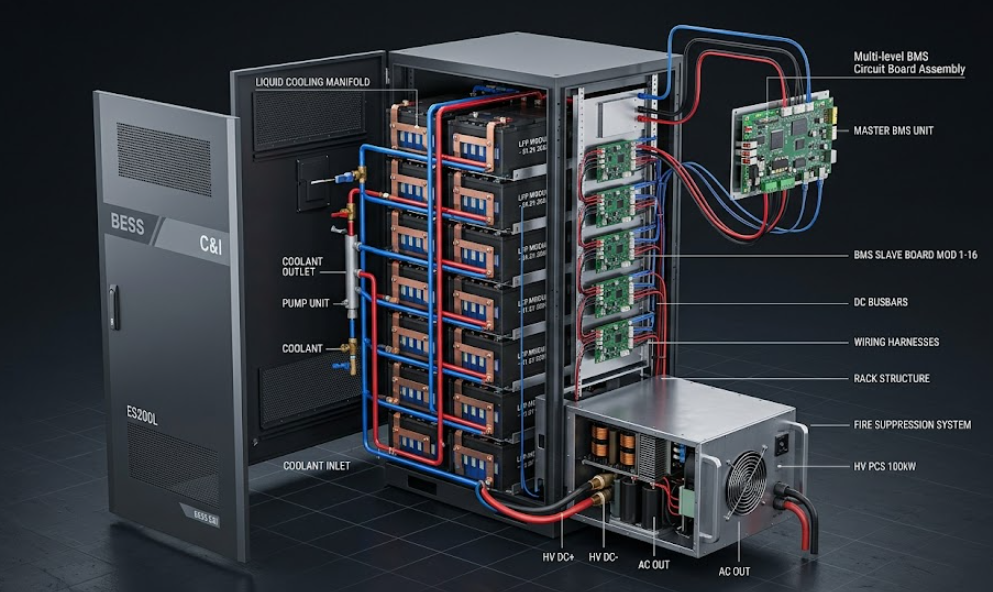
- Battery Management Systems (BMS): Residential units typically utilize a single-level or simple two-level BMS. However, C&I systems employ a highly complex, multi-level BMS (Slave, Master, Central) to safely manage thousands of individual battery cells. Ensuring zero latency in communication across this multi-level architecture is one of our strictest quality control checkpoints.
- Energy Management Systems (EMS) & PCS: Residential systems favor plug-and-play simplicity, often with an EMS integrated directly into a hybrid inverter and managed via a user-friendly app. Conversely, C&I setups require large, high-efficiency Power Conversion Systems (PCS) paired with sophisticated software platforms. These AI-driven EMS platforms are tasked with optimizing complex charging and discharging cycles for maximum economic arbitrage.
- Thermal Management: While residential units often rely on natural convection or small fans, our C&I containers require industrial-grade active liquid cooling or HVAC systems to maintain optimal cell lifespans.
4. Economic Models & ROI: Calculating the Payback
The return on investment (ROI) for BESS varies significantly depending on the target sector.
5. Installation & Safety Standards: Our Top Priority
- C&I Sector: Because C&I systems can tap into multiple revenue streams—such as demand charge reduction, energy arbitrage, and participating in complex grid services (like frequency regulation)—they often yield a faster payback period, typically between 4 to 8 years.
- Residential Sector: Residential ROI is primarily driven by direct electricity bill savings and local incentives. The payback period is highly market-dependent but generally falls between 6 to 10 years.
Safety is a paramount concern for all BESS installations. As a manufacturer, compliance isn’t an afterthought; it dictates our entire component selection process.
All reputable BESS units must comply with UL 9540 (the safety standard for energy storage systems) and UL 1973 (for the batteries themselves).
However, C&I systems face much more stringent hurdles. Because of their massive energy density, C&I installations often require UL 9540A testing—a rigorous large-scale fire test—to demonstrate compliance with commercial fire codes like NFPA 855. This standard dictates specific mandates for system spacing, ventilation, and mandatory fire suppression systems (such as Aerosol or Novec 1230), whereas small residential units usually do not require integrated fire suppression.
While both C&I and Residential BESS are crucial for the future of our clean energy landscape, they are distinct disciplines in terms of scale, complexity, economics, and safety. Understanding these structural and technological differences is essential for anyone looking to invest in, distribute, or develop energy storage solutions.
At Badar Energy, we specialize in navigating these complexities to deliver top-tier, certified BESS hardware. Whether you need customized high-voltage cabinets for a commercial project or reliable residential wall-mounts for your local market, our production lines are ready.


