
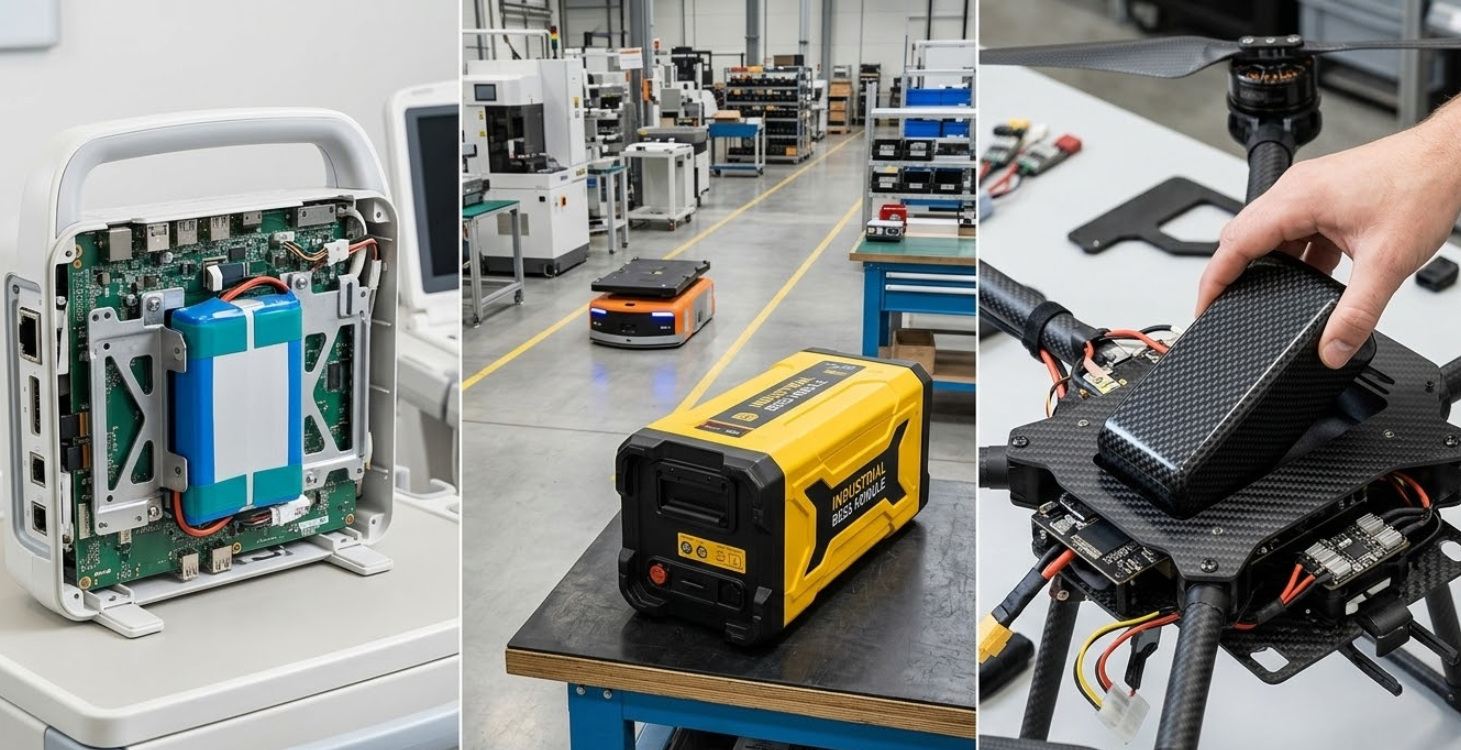
If you’ve ever tried to fit an off-the-shelf battery into a product that wasn’t designed around it, you already know the problem. The cell sits wrong, the BMS doesn’t talk to your firmware, and you end up eating 15% of your device’s internal volume just compensating for the geometry. That’s exactly why custom lithium battery pack OEM manufacturing has grown into a multi-billion dollar segment — not because engineers love complexity, but because standard batteries routinely fail to meet real-world design constraints.
This guide pulls together what actually matters when you’re evaluating an OEM battery pack design and manufacturing service: how the process works, how chemistries compare, what certifications are non-negotiable, and how to separate a credible manufacturer from one that looks good in a catalog. Whether you’re designing for a medical device, industrial equipment, or a consumer drone, the underlying decision framework is largely the same.
What “OEM Battery Pack” Actually Means (and What It Doesn’t)
An OEM battery pack is a cell-based energy storage unit built to a buyer’s specifications — voltage, capacity, physical form factor, connector type, communication protocol, and BMS logic — rather than pulled from a standard product catalog. The OEM manufacturer designs and builds to your requirements; you brand and integrate it into your product.
This is different from buying a standard 18650-based pack and swapping the label. A genuine custom OEM pack starts with a cell selection process, involves iterative mechanical design, includes BMS firmware tuned to your charge/discharge profile, and ends with testing that matches your application environment.
The distinction matters because a lot of manufacturers advertise “custom OEM” but are actually doing light customization on fixed platform designs. When you issue an RFQ, it’s worth asking specifically: can you modify the cell configuration, the PCB layout, and the enclosure independently? If the answer is hedged, that’s a platform play, not true custom manufacturing.
The 6-Step OEM Battery Pack Design Process
Understanding the design sequence helps you know what questions to ask — and where delays typically originate.
Step 1 — Define the electrical requirements. Nominal voltage, capacity (Wh or Ah), peak discharge current, charge rate, and operating temperature range. Don’t just copy these from a competitor’s spec sheet; derive them from your load profile.
Step 2 — Select the cell chemistry. This is where a lot of engineers get anchored too early. The chemistry should follow the application requirements, not the other way around. (See the comparison table below.)
Step 3 — Design the mechanical envelope. Cell configuration (series/parallel), enclosure material, thermal management strategy, connector selection, and mounting interface. For tight form factors, this stage often requires two or three iterations with 3D mockups before committing to tooling.
Step 4 — BMS design and firmware. The battery management system handles cell balancing, state-of-charge estimation, over-current and over-temperature protection, and — for smart batteries — communication over SMBus, I²C, CAN, or UART. The complexity here scales significantly between a basic protective circuit module and a full-featured smart battery compliant with SBDS (Smart Battery Data Specification).
Step 5 — Prototype, test, and iterate. This typically involves electrical performance testing, mechanical stress testing, and thermal cycling. For regulated industries, abuse testing (overcharge, short-circuit, crush) is done here, not after production begins.
Step 6 — Certification and production qualification. UN38.3 for transport, UL 2054 or IEC 62133 for product safety, plus any application-specific certifications (IEC 60601-1 for medical, DO-160 for aerospace). The UN Recommendations on the Transport of Dangerous Goods set the baseline globally.
Chemistry Comparison: Choosing the Right Cell for Your Application
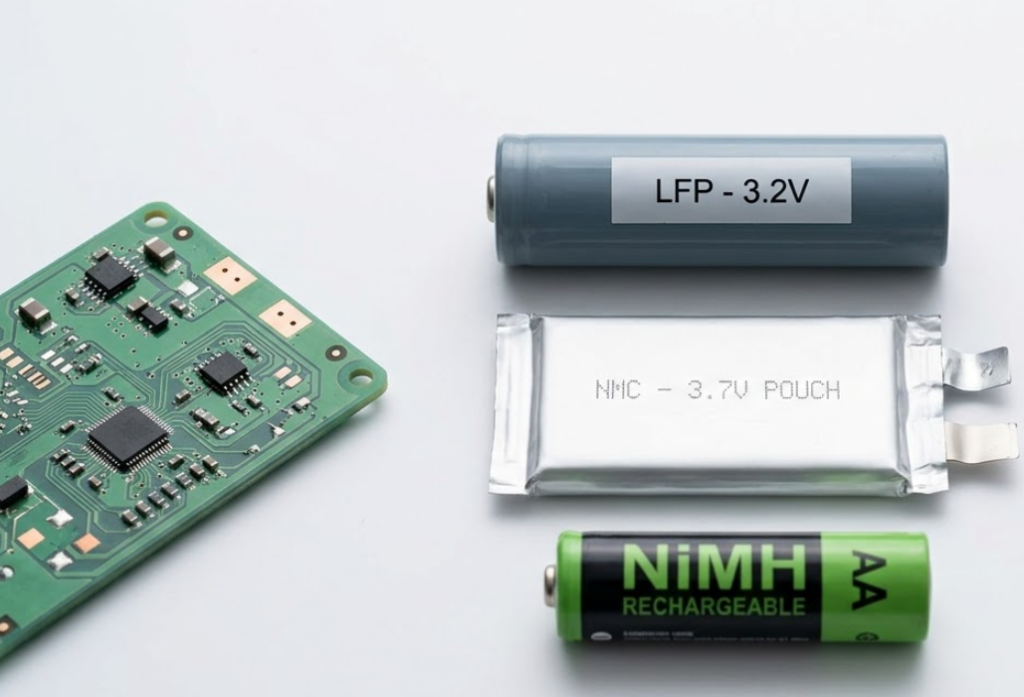
The table below compares the three cell chemistries most commonly used in custom OEM battery packs. Real-world tradeoffs matter more than spec-sheet peaks.
| Parameter | LiFePO₄ (LFP) | NMC (Lithium Nickel Manganese Cobalt) | NiMH |
|---|---|---|---|
| Nominal voltage | 3.2 V/cell | 3.6–3.7 V/cell | 1.2 V/cell |
| Gravimetric energy density | 90–160 Wh/kg | 150–250 Wh/kg | 60–120 Wh/kg |
| Cycle life | 2,000–6,000 cycles | 500–2,000 cycles | 300–1,000 cycles |
| Thermal stability | Excellent — no thermal runaway below 270°C | Moderate — requires robust BMS | Good — non-flammable |
| Cold temperature performance | Poor below −20°C | Moderate | Good down to −40°C |
| Best OEM use cases | Solar storage, industrial, EV | Consumer electronics, drones, medical portables | Legacy medical, military |
| Regulatory complexity | Low–Medium | Medium–High | Low |
| Cost trend (2026) | Decreasing rapidly | Stable–increasing (cobalt supply) | Stable |
For OEM LiFePO₄ battery packs for solar energy storage, LFP is now the clear default — the cycle life advantage over NMC is simply too large to ignore at the system level. For compact portable medical devices where weight is the binding constraint, NMC remains competitive. NiMH is increasingly limited to applications with legacy regulatory approvals or extreme low-temperature requirements.
The U.S. Department of Energy’s Vehicle Technologies Office publishes ongoing cost and performance benchmarks for lithium cell chemistries — useful for validating supplier claims.
Custom vs. Standard Battery Packs: The Real Cost Equation
The most common pushback against going custom is upfront cost. The NRE (non-recurring engineering) fees and tooling charges for a custom OEM pack typically run $5,000–$30,000 depending on complexity. That stings at the prototype stage. But the analysis looks very different over a product’s full lifecycle.
| Cost Factor | Standard Off-the-Shelf Pack | Custom OEM Battery Pack |
|---|---|---|
| Unit cost (high volume) | Higher — margin built in for distribution | Lower — direct factory pricing, no catalog markup |
| NRE / tooling | $0 | $5,000–$30,000 (one-time) |
| Integration labor | High — mechanical workarounds, custom brackets | Low — designed to fit |
| BMS customization | None or limited firmware access | Full control |
| Regulatory testing | Must be repeated if form factor changes | Designed-in from day one |
| Volume break-even point | N/A | Typically 500–2,000 units |
| Supply chain risk | Standard SKUs can be discontinued | Long-term supply agreement with OEM |
| 5-year TCO (10k+ units/yr) | High | 20–40% lower |
The break-even point depends heavily on volume and integration complexity, but for most products shipping more than 1,000 units per year, the custom vs. standard battery pack OEM comparison consistently favors custom beyond the second production year. The BMS control and supply chain stability arguments are often more persuasive than the unit cost math alone.
Vertical Applications: Where OEM Battery Requirements Diverge
The baseline design process is similar across industries, but the compliance requirements — and therefore the supplier qualification bar — vary substantially.
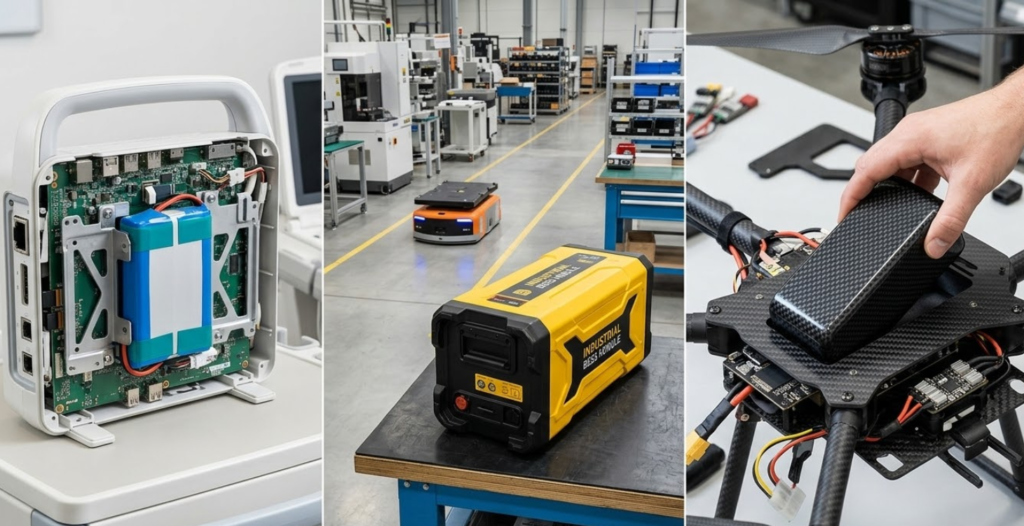
Custom battery packs for medical devices OEM are the most demanding. The applicable standard is IEC 62133, and for the complete device, IEC 60601-1 governs electrical safety. FDA’s 21 CFR Part 820 Quality System Regulation applies to US-marketed Class II and III devices. Expect battery qualification to add 3–6 months to your development timeline. Your manufacturer needs to operate under a documented quality management system — ISO 13485 is the relevant standard, not ISO 9001.
Lithium-ion battery packs OEM for industrial equipment — forklifts, AGVs, robotics — prioritize cycle life, thermal management under sustained high-current discharge, and ingress protection (IP54 minimum for warehouse environments, IP67 for outdoor use). Cycle counts in the thousands are typical, which makes LFP the chemistry of choice for most new designs.
OEM rechargeable battery packs for drone and UAV applications push the opposite direction: maximum energy density, minimum weight. NMC or NCA chemistry dominates. Specific energy above 200 Wh/kg is a common design target, and the BMS must handle high C-rate discharge (15–30C for racing/FPV) without tripping protection during peak current events.
For IoT and connected devices, the emerging requirement is a communicating BMS with state-of-health reporting over BLE or UART — a trend being accelerated by the EU’s Battery Regulation 2023/1542, which mandates battery passports for industrial and EV batteries from 2027.
How to Choose an OEM Battery Pack Supplier: 7 Criteria That Actually Matter
There are hundreds of companies offering custom BMS battery pack OEM manufacturing — particularly from China, where the concentration of cell manufacturing and BMS design capability is highest globally. The following criteria separate manufacturers who can execute from those who can quote.
1. Cell sourcing transparency. Ask which cell suppliers they use and request the cell manufacturer’s datasheet directly. Tier 1 suppliers (CATL, Samsung SDI, Panasonic, BYD, EVE, CALB) publish datasheets with traceable lot testing data. Vague answers about “Grade A cells from certified factories” are a red flag.
2. In-house BMS development. A manufacturer that sources third-party BMS modules can build a functional pack, but they can’t tune firmware for your application or support you when edge-case protection events appear in field data. In-house BMS design capability is the dividing line between a contract assembler and a true development partner.
3. Certification scope and jurisdiction. Verify that the certifications are current, issued by an accredited body (UL, TÜV, Bureau Veritas, SGS), and cover the specific cell chemistry and configuration you’re purchasing. A UL certification for an 18V 5Ah pack doesn’t transfer to your 36V 10Ah design without re-testing.
4. Quality management documentation. ISO 9001 is the floor. For medical, ISO 13485 is required. Ask to see their FMEA (Failure Mode and Effects Analysis) process and recent customer audit results.
5. Tooling and IP ownership. Establish upfront who owns the molds, gerber files, and firmware source code. Many manufacturers retain tooling ownership by default. Negotiate this before NRE payment, not after you’ve paid for tooling you can’t take elsewhere.
6. Production traceability. Each battery pack should carry a serial number tied to a manufacturing record that includes cell lot numbers, BMS test data, and final QC results. This isn’t optional if you’re selling into regulated markets — and it’s increasingly expected in industrial applications as well.
7. Communication cadence and engineering access. A supplier relationship that works looks like: a dedicated engineering contact, documented ECN (engineering change notice) process, and willingness to schedule calls between your team and their BMS engineers during integration. If the only contact is a salesperson, the relationship will struggle under design pressure.
The IEC TC21 technical committee maintains the international standards governing secondary lithium cells and battery packs — worth bookmarking as a reference when evaluating supplier compliance claims.

Certification Reference: What You Actually Need
The certification path is where timelines most often slip. The following are non-negotiable for international shipment and market entry:
UN38.3 — Transport testing for lithium cells and batteries. Required for air freight by IATA, and for most ocean and road freight regulations globally. Tests include altitude simulation, thermal cycling, vibration, shock, external short circuit, impact/crush, overcharge, and forced discharge. Your supplier must provide a UN38.3 test summary report for the exact configuration being shipped — not a generic cell-level report.
IEC 62133 (edition 2) — Safety requirements for portable sealed secondary lithium cells and batteries. Required for CE marking in the EU and referenced by many national market approval schemes.
UL 2054 — North American standard for household and commercial batteries. Required for retail distribution and many OEM device certifications in the US and Canada.
Application-specific additions: IEC 60601-1 (medical), DO-160G (aviation), IEC 61010-1 (laboratory and measurement equipment), MIL-PRF-32565 (US military).
Plan for 8–16 weeks from final design freeze to certification completion, and budget $8,000–$25,000 for a full UN38.3 + IEC 62133 + UL 2054 test campaign on a new pack design. Testing at a pre-approved facility reduces the risk of requirement interpretation issues.
The Procurement Checklist Before Issuing Your First RFQ
Before you contact a single manufacturer, have the following documented:
- Nominal voltage and capacity; min/max voltage limits
- Peak and continuous discharge current; charge rate (C-rate)
- Operating temperature range (charge and discharge separately)
- Mechanical envelope constraints (max dimensions, mounting pattern)
- Connector type and pinout
- Communication interface requirement (if any)
- Certification target markets
- Annual volume forecast (Year 1 and Year 3)
- IP ownership requirements
Sharing this up front compresses the quoting cycle from weeks to days, and separates manufacturers who understand your application from those generating generic responses.


