
1. Core Revenue Streams: From Single Dimension to “Value Stacking”
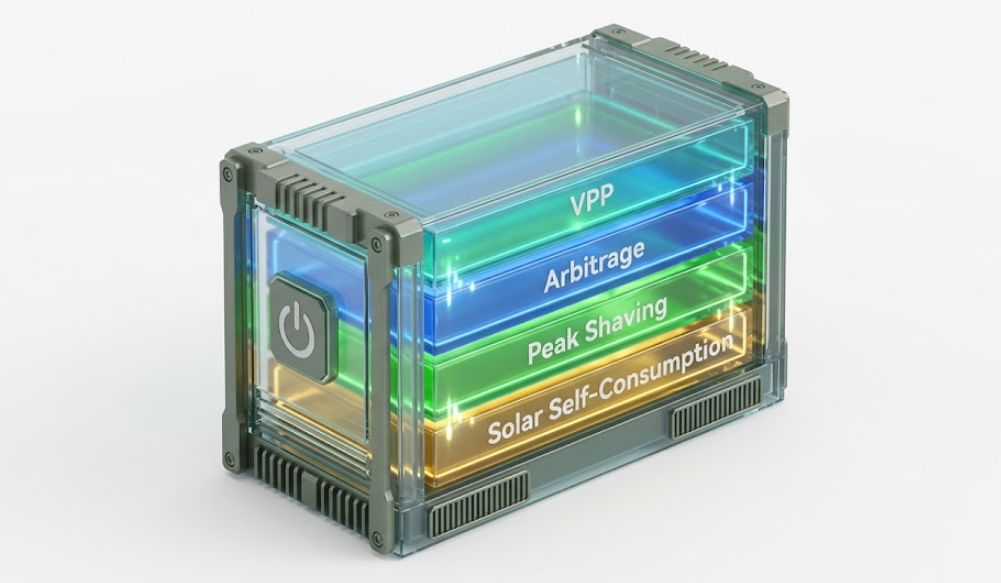
According to Lazard’s annual Levelized Cost of Storage (LCOS) report, ROI based solely on peak-valley arbitrage is narrowing. Leading manufacturers are adopting a “Value Stacking” model, where a single hardware system serves multiple revenue streams simultaneously.
1.1 Time-of-Use (TOU) Arbitrage
The foundational revenue for C&I storage. In high-tariff regions like California (CAISO), Germany (EEX), or major industrial hubs in China, plants charge during “off-peak” hours with the lowest rates and discharge during “peak” production hours.
•Evidence: In regions with a price spread of $0.10-$0.15/kWh, a dual-cycle (two charges, two discharges) strategy can bring the payback period under 5 years.
1.2 Demand Charge Management (Peak Shaving)
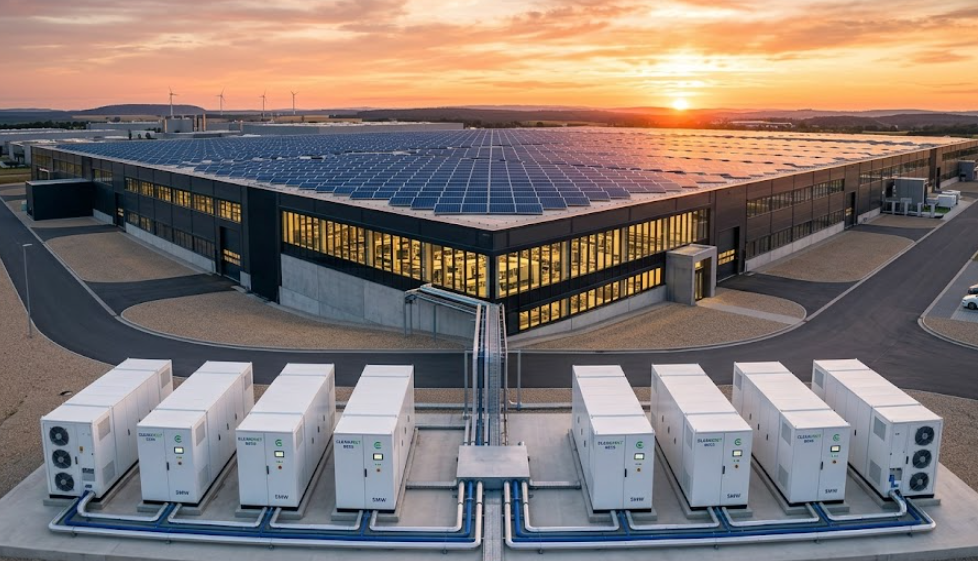
For large plants, 20%-40% of the electricity bill is often based on “Maximum Demand.” The ESS discharges when the plant’s load reaches a preset threshold, lowering the peak power perceived by the grid and reducing monthly fixed demand charges.
•Evidence: Research by BloombergNEF (BNEF) shows that for heavy industries with volatile loads (e.g., mold manufacturing, steel processing), demand management often yields higher returns than simple arbitrage.
1.3 Ancillary Services & Demand Response
Plants participate in grid frequency regulation (FR), voltage support, or emergency demand response via aggregators. This earns direct cash compensation or significant tariff rebates.
Table 1: Comparison of C&I ESS Revenue Streams
| Revenue Stream | Type | Key Variable for ROI | Expected Revenue Share |
| TOU Arbitrage | OpEx Savings | Price Spread, Round-Trip Efficiency (RTE) | 40% – 60% |
| Demand Management | Fixed Cost Reduction | Load Forecast Accuracy, Discharge Power | 20% – 30% |
| Solar Self-Consumption | Opportunity Cost | PV Capacity, Self-Consumption Rate | 10% – 20% |
| Ancillary Services | Extra Income | Market Policy, Response Speed | 5% – 15% |
2. Technical Metrics: Quantifying Performance into Financial Results
2.1 Cycle Life and LCOS (Levelized Cost of Storage)
ROI depends not just on the purchase price, but on the LCOS over the system’s life.
•Expert Insight: Mainstream LFP batteries are typically required to reach 6,000 cycles (80% SOH) at a 0.5C rate.
•Logic: LCOS = (Initial Investment + O&M – Residual Value) / Total Lifetime Discharge. Increasing cycle life from 5,000 to 8,000 cycles can reduce LCOS by approximately 30%.
2.2 Round-Trip Efficiency (RTE)
RTE represents the efficiency of energy going in and coming out.
•Data: Systems from top integrators (e.g., Tesla Megapack, CATL EnerOne, AlphaESS) typically achieve 88%-92% RTE. A 3% drop in RTE can lead to tens of thousands of dollars in energy losses over 10 years.
2.3 Thermal Management: Liquid vs. Air Cooling
•Experience: In high-temperature environments, air cooling can cause temperature deltas of over 5°C within a battery cluster, shortening life due to the “weakest link” effect. Liquid cooling keeps the delta under 3°C, extending cycle life by over 10%.
3. Intelligent Dispatch: AI-Driven EMS as the ROI Engine
Hardware is the body; the Energy Management System (EMS) is the brain.
3.1 Dynamic Peak Shaving via Load Forecasting
Advanced EMS uses machine learning to predict the next 24 hours of load based on weather, production schedules, and historical data.
•Case Evidence: An auto parts factory increased its demand management success rate from 82% to 98% by implementing AI algorithms, saving an extra $12,000 annually.
4. Authoritative Case Studies
Case A: Precision Machining Plant in Germany (C&I Solar + Storage)
•Background: Annual consumption of 5M kWh with high peak prices and strict carbon quotas.
•Config: 1MW / 2MWh LFP ESS + 1.2MW Rooftop PV.
•Data:
•CAPEX: ~€750,000.
•Annual Savings: €165,000.
•Subsidies (BAFA): Covered 20% of initial investment.
•Actual ROI: 3.8 years payback, 19.5% IRR.
Case B: Textile Factory in Jiangsu, China (Demand Charge Management)
•Background: Highly volatile load from heavy machinery.
•Config: 500kW / 1.1MWh Liquid-Cooled ESS.
•Results:
•Demand Reduction: Consistently shaved 450kW from monthly peak.
•Monthly Income: $2,500 (Demand) + $4,500 (Arbitrage) = $7,000/month.
•Payback: 4.2 years.
5. ROI Evolution: From Arbitrage to VPP
The value of storage assets will transition through three stages:
1.Fixed Returns: Relying on subsidies, fixed spreads, and demand management (Current Market).
2.Market Participation: Trading based on 15-minute real-time spot prices, increasing revenue potential by 20%-50%.
3.VPP Synergy: Thousands of systems aggregated into a “Virtual Power Plant,” competing with traditional power plants for high-premium grid services.
6. Conclusion & Strategic Advice (E-E-A-T Summary)
1.Prioritize Liquid Cooling: Despite 5%-8% higher CAPEX, the long-term financial performance from life extension far outweighs air cooling.
2.Scrutinize EMS Software: Ensure the provider supports AI load forecasting and VPP readiness.
3.Focus on LCOS: Don’t be misled by low initial prices; focus on residual value and SOH guarantees after 6,000 cycles.
4.Safety First: Ensure compliance with UL9540A or GB/T 36276 to avoid ROI-killing accidents.


