
Driven by energy transition and electricity price reforms, industrial and commercial energy storage has evolved from a mere “backup power source” into a “profitable asset” on corporate financial statements. However, for many factory decision-makers, does an investment of millions truly yield returns within expectations? And how does the quality of an energy storage Pack directly influence every penny of that return? This article will thoroughly dissect the economic logic behind industrial and commercial energy storage.
I. Core Revenue Streams: More Than Just “Buying Low, Selling High”
The economic value of industrial and commercial energy storage is not singular but stems from a comprehensive revenue model composed of multiple dimensions:
1. Peak-Valley Arbitrage (Core Revenue)
This is currently the most straightforward revenue method. It involves charging the energy storage system during off-peak electricity price periods and discharging during peak periods to offset high electricity costs. According to the latest grid agency procurement prices in April 2026, the peak-valley price difference in many regions across China has exceeded 0.7 CNY/kWh, with some areas like the Pearl River Delta and Shanghai even surpassing 1.2 CNY/kWh [3] [5].
- Calculation Formula: Daily Revenue = Battery Capacity × Depth of Discharge (DOD) × Charge-Discharge Efficiency × Peak-Valley Price Difference × Cycle Times.
2. Demand Charge Reduction (Cost-Saving Tool)
For large industrial users subject to two-part electricity tariffs, demand charges account for 20%-30% of the total electricity bill. An energy storage system can reduce the factory’s maximum demand power through “peak shaving,” thereby decreasing the fixed demand charges paid to the grid each month.
3. Demand-Side Response and Subsidies
Many local governments (e.g., Guangdong, Zhejiang, Jiangsu) have introduced subsidies for energy storage discharge, typically ranging from 0.1-0.3 CNY/kWh. Additionally, participating in electricity market demand-side response can earn enterprises extra compensation for peak regulation.
II. Cost Breakdown: From Initial Investment to LCOS
Evaluating whether an energy storage project is worthwhile requires looking beyond the purchase price to consider the Levelized Cost of Storage (LCOS).
| Cost Component | Description | Impact on Economics |
| Initial Investment (CAPEX) | Includes battery Pack, PCS, EMS, civil works, and installation. | Determines the starting point for project capital recovery. |
| Cycle Life | High-quality Packs can achieve 6000-8000 cycles. | Determines the length of the revenue cycle. Doubling the lifespan halves the cost per kWh. |
| Round-Trip Efficiency (RTE) | Overall charge-discharge efficiency of the system (typically 85%-90%). | Every 1% increase in efficiency translates to tens of thousands of CNY in additional annual arbitrage profit. |
| Operation & Maintenance (OPEX) | Includes monitoring, thermal management energy consumption, and regular inspections. | Higher intelligence leads to lower long-term costs. |
III. Why is a Pack Manufacturer the “Guardian of Your Returns”?
As the core of an energy storage system, the performance of the battery Pack directly determines whether the financial equation balances out favorably:
- Thermal Management and Degradation Control: An excellent Pack design can control the temperature difference between cells within 3℃. For every 10℃ increase in temperature, battery life can be halved. This means a low-quality Pack might experience significant capacity degradation by the 4th year, preventing the project from achieving its expected 8-10 year payback period.
- Depth of Discharge (DOD) and Usable Capacity: A 100kWh cabinet with a high-quality Pack might support 95% DOD without impacting lifespan, while a standard product might only recommend 80% DOD. This 15% difference directly impacts daily arbitrage revenue.
- Safety and Business Continuity: A single thermal runaway incident is not just equipment loss; it represents the enormous cost of factory downtime. Choosing a Pack manufacturer with high safety standards is essentially purchasing “business continuity insurance.”
IV. Practical Calculation: Taking a 100kW/215kWh Energy Storage Cabinet as an Example
Assume a factory in Guangdong, implementing a two-charge, two-discharge strategy, with an average peak-valley price difference of 0.8 CNY/kWh:
- Daily Arbitrage Revenue: 215kWh × 90% (DOD) × 90% (Efficiency) × 0.8 CNY × 2 cycles ≈ 278 CNY/day.
- Annual Revenue (calculated for 330 days): Approximately 91,700 CNY/year.
- Static Payback Period: If the initial investment is 250,000-300,000 CNY, relying solely on arbitrage, the payback period is about 3-3.5 years. Including demand charge reduction and government subsidies, the payback period could shorten to around 2.5 years.
V. Conclusion: Is Now the Best Time to Enter the Market?
The answer is yes. With the completion of the “market-driven” transformation in 2025 [11], energy storage is no longer a policy-mandated requirement but an inevitable choice for enterprises to enhance energy resilience and reduce operating costs.
For decision-makers, “what is saved is earned.” However, when making a purchase, it is crucial to avoid the “low-price trap” and focus on the technical expertise of the Pack manufacturer. Because in the long race of energy storage, only high-quality Packs can ensure your “financial account” remains profitable for the next decade.
VI. Revenue Simulation Chart: The Long-Term Compounding Effect of Quality Packs
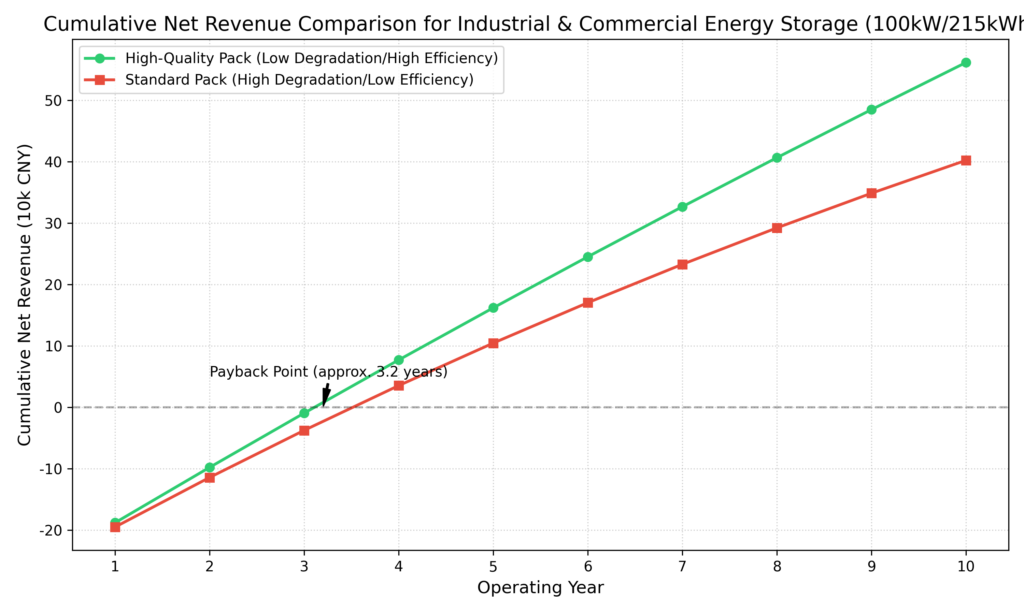
As the comparison shows, despite similar initial investments, high-quality Packs, thanks to lower capacity degradation and higher energy efficiency, significantly widen the revenue gap with standard products after the 5th year of operation. By the 10th year, the cumulative net revenue from high-quality Packs is approximately 25% higher than that from standard products. This illustrates the power of “long-termism” in energy storage investment.


