
Let’s get straight to a hard truth in the renewable energy sector: treating wind power storage exactly like solar power storage is a fast track to ruining a multi-million dollar battery system.
In the commercial storage industry, “Solar + BESS” has largely become a standardized, plug-and-play solution. But here on the manufacturing floor at Badar Energy, we regularly get calls from project developers who took a standard, off-the-shelf solar battery cabinet and hooked it up to a wind turbine. Eighteen months later, the battery cells are degraded, the inverters are tripping off-grid, and the client is furious.
Why does this happen? Because wind energy is fundamentally more violent and erratic than solar. Integrating wind power doesn’t just require a big battery; it demands heavy-duty Power Conversion Systems (PCS) and a highly advanced Battery Management System (BMS) that can handle absolute chaos.
Let me break down the engineering reality of why wind storage is a completely different beast.
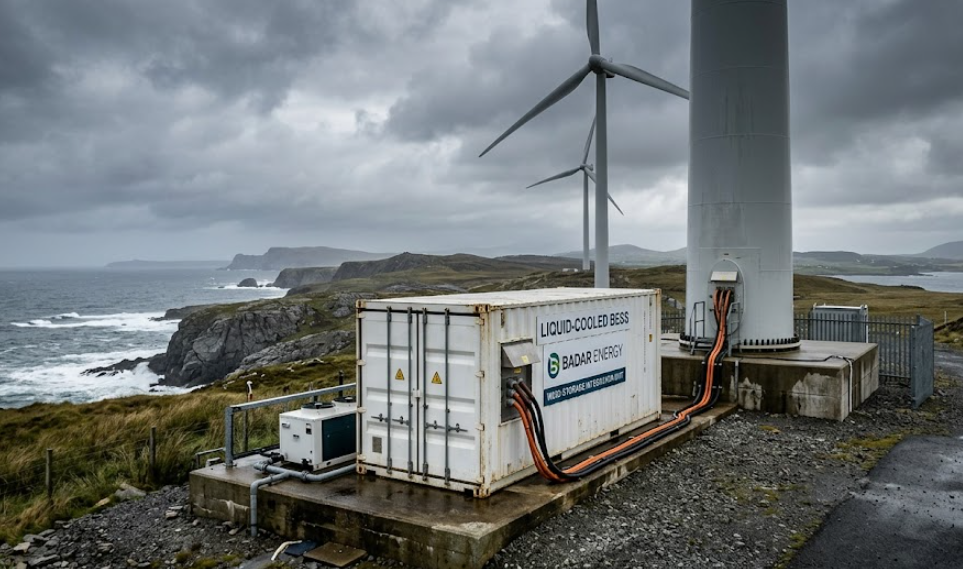
1. The Nature of the Beast: Predictable Solar vs. Chaotic Wind
If you look at the power generation curve of a solar array, it’s a beautiful, predictable bell curve. The sun comes up, power ramps up slowly, peaks at noon, and fades out. It generates clean Direct Current (DC) that plays very nicely with DC battery racks.
Wind is a completely different story. It’s highly volatile. You are dealing with sudden gusts, instantaneous drops, and extreme intermittency. A wind turbine generates Alternating Current (AC) accompanied by significant harmonic distortion.
To put it in human terms: Solar storage is a marathon runner maintaining a steady, predictable pace. Wind storage is a high-intensity interval athlete, requiring the hardware to sprint at maximum output, dead-stop, and sprint again in a matter of milliseconds.
2. Why the PCS Works Overtime in Wind Applications
Because wind turbines generate AC power, your BESS must handle complex AC-to-DC-to-AC conversions. This means the PCS (the heart of your energy storage system) works overtime.
Wind turbines generate “dirty” power. Sudden mechanical gusts cause massive voltage spikes and frequency deviations. If your PCS isn’t built to act as an aggressive, ultra-fast filter, those spikes will either trip the system entirely or pass through and damage the microgrid. Furthermore, wind farms are often relied upon for grid frequency regulation. This requires the PCS to have massive overload capabilities to provide instantaneous reactive power compensation.
PCS Hardware Demands: Solar vs. Wind Integration
| Engineering Metric | Solar + BESS (Typical) | Wind + BESS (Required) | The Engineering Reality |
| Response Time | Slower (~100-200 ms) | Ultra-fast (< 20 ms) | Wind gusts cause immediate frequency shifts; the PCS must react instantly to inject or absorb power to stabilize the grid. |
| Overload Capacity | Standard (110% for 1 min) | High (120%-150% for 1 min) | Turbines have massive starting currents and sudden power surges that the PCS must aggressively absorb. |
| Harmonic Filtering | Moderate (THDi < 5%) | Extreme (THDi < 3%) | Wind generators create heavy electrical “noise.” The PCS must clean this dirty power before it hits the facility. |
| Coupling Type | Usually DC-Coupled | Strictly AC-Coupled | Forces a much more complex, heavy-duty bidirectional inverter design. |
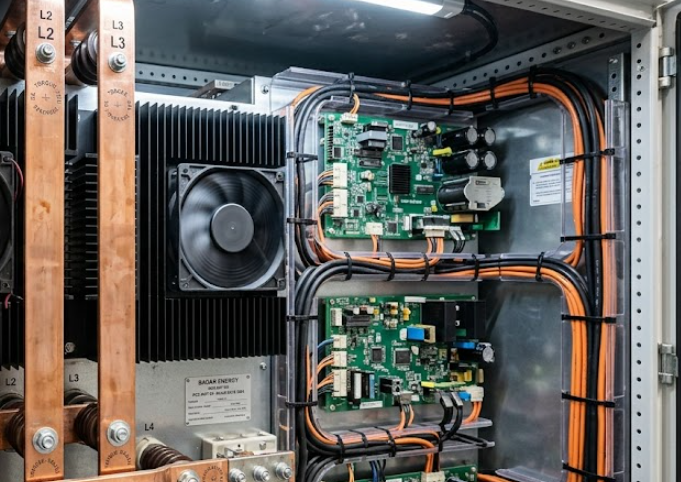
3. The BMS Nightmare: Taming “Micro-Cycling”
The quickest way to kill a lithium battery is to confuse its Battery Management System (BMS). In a wind application, the wind might blow hard for 10 seconds (charging the battery), drop to zero for 5 seconds (forcing the battery to discharge to support the load), and then gust again.
We call this “Micro-Cycling.”
Under these conditions, a standard BMS algorithm using simple voltage-based Coulomb counting will drift wildly. Within a few weeks, the BMS will lose track of the battery’s true State of Charge (SoC). It will think the battery is at 50% when it’s actually at 10%, leading to deep discharges that permanently damage the LFP chemistry.
Even worse is the cell balancing issue. Standard solar batteries use passive balancing (bleeding off excess voltage from high cells as heat). That is far too slow for wind. Wind BESS requires high-current Active Balancing—physically transferring energy from high-voltage cells to low-voltage cells in real-time to keep the pack healthy during chaotic charge states.
BMS Algorithm & Hardware Stress Comparison
| BMS Capability | Solar Storage Environment | Wind Storage Environment | Why Standard Systems Fail |
| Switching Frequency | 1-2 times per day (Predictable) | Hundreds of times per hour | Constant switching fries standard contactors. Wind requires heavy-duty, automotive-grade relays. |
| SoC Estimation | Simple Coulomb Counting | Advanced Kalman Filtering / AI | Micro-cycling causes standard algorithms to “drift,” causing unexpected system shutdowns. |
| Balancing Strategy | Passive Balancing (Low current) | Active Balancing (> 2A current) | Cells fall out of sync rapidly under erratic wind loads. Active balancing is mandatory for a 10+ year lifespan. |
| Thermal Load | Gradual heating during noon | Sudden, extreme thermal spikes | Makes advanced liquid-cooling thermal management an absolute necessity over standard air cooling. |
4. Real-World Case Study: Stabilizing a Coastal Industrial Microgrid
Theory only goes so far. Let’s look at how this plays out in the field.
Recently, we worked with a coastal manufacturing facility that runs heavy industrial plastic extruders. They relied on a local 5MW wind turbine to offset their massive energy costs. The problem? When the wind dropped suddenly, the voltage sagged. If you manufacture anything with an extruder, you know that if the machine loses power mid-run, the plastic solidifies inside the barrel and ruins the screw. It’s a costly nightmare.
They had installed a standard, cheap BESS to fix this, but the severe wind micro-cycling degraded the battery cells to 70% capacity in just 18 months, and the PCS couldn’t react fast enough to save the extruders from tripping.
The Engineered Solution: Our Badar Energy engineering team ripped out the old system and deployed a customized 2MW/4MWh LFP liquid-cooled system built specifically for wind integration.
- We upgraded the PCS to feature a sub-15ms response time for instantaneous active power injection the millisecond the turbine output dropped.
- We integrated a proprietary BMS with dynamic active balancing and a custom algorithm tuned strictly for wind-profile micro-cycling.
The Result: The facility’s power quality was completely stabilized to strict grid standards. Extruder downtime due to voltage sags was reduced to zero. Most importantly, after two full years of brutal coastal operation, our remote monitoring shows the battery degradation curve tracking at less than 1.8% annually.

You cannot treat wind energy storage like a big solar battery. Slapping a standard, passively-balanced battery onto a highly volatile wind turbine is a guaranteed recipe for catastrophic hardware failure and a ruined ROI.
When dealing with the chaotic nature of wind power, the intelligence of your inverters and management software matters just as much as the quality of your lithium cells. Choose a BESS manufacturer who understands the industrial realities of the grid, not just someone selling metal boxes.


