For modern commercial facilities, continuous electricity is not just a utility—it is the lifeline of operations. Aging grid infrastructure, coupled with increasingly severe weather events, has made reliable power a major concern for facility managers and business owners alike.
When the lights go out, the losses extend far beyond a few hours of darkness. Lost production, spoiled inventory, and corrupted data can cripple a company’s bottom line. To combat this, forward-thinking enterprises are investing heavily in a commercial BESS (Battery Energy Storage System) to secure their energy independence and ensure absolute operational stability.

The Real Cost of Commercial Power Outages
Many businesses underestimate the financial impact of grid failures. The cost of commercial power outages is staggering. According to data published by the U.S. Department of Energy (DOE), power outages cost the U.S. economy billions of dollars annually. For a single commercial building, even a momentary lapse in power can result in a cascade of expensive problems.
Table 1: Average Cost of Downtime by Commercial Sector
| Commercial Sector | Estimated Cost per Hour of Downtime | Key Vulnerability |
| Data Centers | $300,000 – $500,000 | Data loss, server corruption |
| Manufacturing | $50,000 – $150,000 | Production line halt, ruined materials |
| Healthcare | $10,000 – $50,000 | Patient safety, equipment reset |
| Retail & Supermarkets | $5,000 – $20,000 | Inventory spoilage, lost POS sales |
Battery Backup vs Diesel Generator: The Shift in 2026
Historically, commercial buildings relied on loud, polluting diesel generators for emergency power. However, the debate of battery backup vs diesel generator is rapidly shifting. Replacing diesel generators with batteries is no longer just an environmental initiative; it is a superior technical and financial decision. Research from the National Renewable Energy Laboratory (NREL) highlights that distributed battery systems offer faster response times and greater grid resilience.
Table 2: Commercial Battery Backup vs. Traditional Diesel Generator
| Feature | Commercial Lithium Battery Backup | Traditional Diesel Generator |
| Startup Time | Instant (Zero downtime) | 10 to 30 seconds delay |
| Emissions | Zero carbon emissions | High CO2 and particulate matter |
| Noise Level | Silent operation | 80+ decibels (requires soundproofing) |
| Maintenance | Minimal (Smart remote monitoring) | High (Fuel filtering, oil changes, testing) |
| Fuel Cost | Zero (Charges via grid or solar) | High and volatile diesel prices |
Key Benefits of a Commercial BESS
Investing in a commercial lithium battery backup offers multi-layered advantages that traditional generators simply cannot match.
Uninterruptible Power Supply for Zero Downtime
In critical environments, even a 10-second delay while a diesel generator starts up is unacceptable. A commercial BESS acts as an industrial-scale UPS. The transition from grid power to battery power is instantaneous, providing true zero downtime power solutions that protect sensitive machinery and IT infrastructure from voltage sags and blackouts.
Peak Shaving and Load Shifting for Bill Reduction
Unlike a generator that sits idle until an emergency, a battery system works for you every day. Through peak shaving and load shifting, the system charges during off-peak hours when electricity is cheap and discharges during peak hours when rates are highest. This strategically avoids punitive “Demand Charges” on your commercial utility bill.
Smart Grid Integration with EMS
Modern storage solutions are driven by an intelligent Energy Management System (EMS) for buildings. This software automatically optimizes charge/discharge cycles, monitors battery health, and can seamlessly integrate with existing rooftop solar panels to maximize your facility’s use of renewable energy.
Case Study: Manufacturing Resilience
A mid-sized precision manufacturing plant frequently suffered from micro-outages, causing robots to reset and ruining raw materials. By installing a 500kW/1MWh commercial BESS, they achieved zero downtime. Furthermore, utilizing the system for peak shaving reduced their monthly demand charges by 30%, putting them on track to achieve full ROI in just 3.5 years.

Why LiFePO4 is the Top Choice for Commercial Lithium Battery Backup
When selecting a system, the battery chemistry matters immensely. Among the options, LiFePO4 commercial battery systems (Lithium Iron Phosphate) have emerged as the industry gold standard for commercial and industrial applications.
As a proven technology, LiFePO4 offers superior thermal stability, meaning there is virtually no risk of thermal runaway or fire—a critical compliance factor for commercial buildings.
Table 3: Battery Chemistry Comparison for Commercial Storage
| Metric | LiFePO4 (LFP) | NMC (Lithium Nickel Manganese Cobalt) | Lead-Acid |
| Safety & Stability | Excellent (No thermal runaway) | Moderate (Requires intense cooling) | High (Hydrogen gas leak risk) |
| Cycle Life | 6,000 – 8,000+ cycles | 2,000 – 3,000 cycles | 500 – 1,000 cycles |
| Cost over Lifespan | Lowest (Best long-term ROI) | Moderate | High (Needs frequent replacement) |
| Ideal Application | Commercial, Industrial, Microgrids | EVs, Space-constrained devices | Short-term small backup |

Calculating the ROI of Commercial Battery Storage
Understanding the ROI of commercial battery storage requires looking at both CapEx (Capital Expenditure) and OpEx (Operational Expenditure). While the initial investment in a BESS might be higher than a diesel generator, the operational costs are incredibly low. You eliminate fuel purchases, drastically reduce maintenance contracts, and most importantly, actively save money every month by slashing peak demand utility charges.
4 FAQs About Commercial Battery Backup
1. How long can a commercial battery backup power a building?
It depends entirely on the system’s capacity (kWh) and your building’s critical load. Systems can be customized to provide anywhere from 2 hours to over 24 hours of continuous backup power.
2. What is the lifespan of a commercial BESS?
Premium systems utilizing LiFePO4 chemistry are designed to last 10 to 15 years, or over 6,000 to 8,000 charge cycles, before degrading to 80% of their original capacity.
3. Can battery storage replace a diesel generator completely?
Yes. In many commercial setups, especially when paired with commercial solar arrays, a properly sized battery system can entirely replace the need for a diesel generator.
4. Are there tax incentives for commercial battery storage?
Yes, many regions offer significant incentives. In the U.S., the Investment Tax Credit (ITC) allows businesses to deduct a substantial percentage of the installation cost from their federal taxes.
Clean Energy, Bright Future: Badar Energy’s Lithium Battery CommitmentChange block type or style
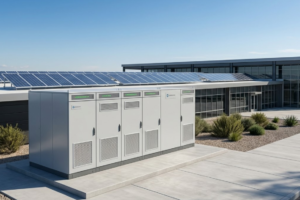
Modern systems are highly modular. They can be installed in compact, weather-proof outdoor cabinets or standardized shipping containers, saving valuable indoor real estate.